


Women don’t usually push themselves to lose 20
pounds right before bathing suit season for their health. The $40-odd
billion diet industry does not exist because so many people are
concerned about their health. By and large, people do not seek out
weight-loss surgery “for their health.” And teenage girls do not
become anorexic for their health. What most women want is to look more
attractive, which they believe means being thinner. When pharmaceutical companies want a controversial
drug approved, they hire high-priced experts to testify about the
apparent link between obesity and health problems, the high cost of
illnesses that are supposedly caused by weight, and the “well-known”
improvements in certain health symptoms associated with losing some
weight. However, drug company marketing departments know that big bucks
for the new meds roll in for other reasons: to take away the pain of
living in a society that makes fun of fat people, and, if possible, to
get sexier thighs by summer. Keep that in mind the next time that someone says
that he or she is just concerned about your health. Maybe so, maybe not.
Tom Ammiano, a thin man who is president of the board of supervisors, introduced the proposed legislation to add “body size” to the list of city-banned forms of discrimination, including those based on race, sex, religion, age, sexual orientation, disability, and place of birth. Mr. Ammiano was formerly a stand-up comedian and admits that at one time he, like his fellow comedians, told “fat jokes.” In proposing the new legislation, Ammiano encouraged us by demonstrating that people can become enlightened and their disregard for fat people can change into respect. The result of all this activism: On May 8, 2000, the board of supervisors unanimously approved the new legislation. I picked up my New York Times on May 9 and was thrilled to find very respectful coverage of the event in the “hard news” section, along with a nice photo of supporters of the proposed city ordinance, including Marilyn Wann, Jason Fisher, and Nancy Gold. The New York Times titled its article “New San Francisco Ordinance Decrees That All Sizes Fit.” Other media coverage included a Reuters article, “A Weighty Victory,” in many newspapers and on the Internet on AOL on May 8 and ABCNews.com on May 9. Reuters quoted Mr. Ammiano as saying, “Many San Franciscans are being denied employment, housing, and bank loans merely because they are perceived as being overweight. Clearly, discrimination in any form is wrong.”
Reuters closed its article with a quote from activist Nancy Gold: “Fat people can no longer be told they can’t have a job just because they don’t have ‘front-office appeal.’ The law can do that. That’s how racism was changed, that’s how sexism was changed, and that’s how sizism is going to change.” On May 11, an editorial published in the New York Times opposed the legislation and urged Mayor Willie Brown to veto it. Titled “Trivializing Discrimination,” it sympathized with large persons who have experienced bias but cited questionable health statistics and the belief that at least some fat people can lose weight. The following day, the paper printed a handful of rebuttal letters, including one from W. Charisse Goodman, author of The Invisible Woman—Confronting Weight Prejudice in America. On May 26, 2000, Mayor Willie Brown signed the legislation to ban discrimination based on body size, and San Francisco became the fourth city in the United States to officially uphold the ideals of tolerance and size-friendly public accommodations. I don’t believe that any legislation in any one city or even at the federal level can obliterate racism, sexism, or sizeism. Sometimes such laws can even provoke a backlash. Nonetheless, legal remedies for patently unfair behavior must exist in a society that claims to be civilized. They can be useful tools in our battle against size discrimination. And I have always felt that if we are to have such laws, the focus should be on adding terms such as size to already existing protections under the law; such was the nature of the San Francisco statute that passed. My congratulations and thanks to all those who were involved in convincing San Francisco to support diversity! Well done!
A large color photo of Ms. Collins revealed a woman who can dress nicely for a job interview and should not be an embarrassment in the “front office.” The text made it obvious that she is qualified as an office manager or a paralegal. Just the same, Collins has had an uphill battle finding a good job after being terminated in a general layoff, even in this time of supposedly plentiful employment. Would it help if she moved to San Francisco, with its new legal protection on the books? Perhaps, but there are always those employers who still refuse to hire ethnic minorities or older workers, even though it is illegal to discriminate against them. Or they will offer jobs lower in responsibilities and pay than the applicant’s qualifications clearly dictate. In other activism news, Elizabeth Fisher has expanded her battle to get automakers who sell cars in the United States to make seat belt extenders available. You may recall my praise in this column for her efforts and for her web site, ifisher.com, in targeting the most important holdout, Honda. Although many manufacturers voluntarily make longer belts or extenders available free or for a nominal price, a few do not. Honda, a best-selling car made in the United States, does not. On behalf of Ms. Fisher, U.S. Senator John Breaux of Louisiana contacted the National Highway Traffic Safety Administration (NHTSA). This paved the way for Fisher’s petition asking the NHTSA to amend the Code of Federal Regulation 49CFR451.209, which currently requires vehicle manufacturers to make seat belts to fit people who weigh, in some cases, no more than 215 pounds.
Recent publicity about NHTSA revisions of air bag regulations makes it clear that as few as one hundred or so letters from citizens can make administrators reconsider their policies. In the case of current seat belt regulations, it is downright terrible public policy to ignore the needs of the largest of automobile drivers and passengers, especially when it concerns safety equipment that can be easily modified. As citizens, we need to point out the obvious. One final bit on activism. Some readers may recall the sad case of Pat Mullen, the supersize Chicago mother who died suddenly on May 6, 1996, and whose body was treated with disrespect by the Chicago Police Department. I wrote about the case in this column in Winter 1997. There were protracted hearings and publicity at that time, but no resolution of the case or further information was reported. Now, according to Chicago size-acceptance activist Donna Marie Ryan, who has followed the case closely, I’ve learned that two police officers involved were quietly suspended without pay for thirty days. Meanwhile, a friend of Ms. Mullen, Evelyn Makris, is raising Mullen’s three daughters, ages eleven, thirteen, and sixteen, on an extremely limited (fixed) income. Those who would like to offer financial support, clothing, or other help can contact Ms. Makris at EMakris@webtv.net. I’d like to thank Donna Marie Ryan for her tenacious pursuit of this case and her help with others.
I continue to marvel at advertising in Walmart circulars. One that was dated March 1, 2000, had no fewer than four plus-size models, including children, all identified as real people, either employees or family members of employees. Walmart’s ad execs deserve some kind of award. Speaking of real-life models: In March 2000, the Fashion Bug chain of women’s clothing stores put on a promotion with the League of Women Voters, featuring fashion shows called Salute to Voting Women. Posters in their windows and store fliers read, “Models Wanted—all sizes, all ages, no experience necessary!” Did you see the April 17, 2000, Jet magazine? The cover story was “Large and in Charge: Full-Figured Celebrities Proud of Their Stature.” Great title! It does seem that magazines geared toward African-Americans, such as Jet, Ebony, and, of course, Belle, are far ahead of those focused more on white readers when it comes to celebrating body sizes.
On March 27, 2000, the TV show called Third Watch (NBC-TV) aired an episode with the following plot: Rescue crews must demolish walls to extricate an extremely obese woman from her home. People who tuned in to the show apprehensively, expecting the usual sensational Jerry Springer–type treatment of the topic, were pleasantly surprised to see the story handled with some sensitivity. Sophie Kostides, an officer of NAAFA’s Connecticut chapter, played the lead. This scenario is, in fact, sometimes played out in real life. Fortunately, TV crews and National Enquirer photographers are not always around when it happens. Very large people who become virtual prisoners in their home, due to agoraphobia and embarrassment about going outside (and perhaps) weight-related loss of mobility, sometimes have to be rescued in the manner portrayed in Third Watch. Such drastic measures as demolishing part of a wall or widening a doorway are called for only when a group of rescue workers must surround the patient and carry him or her outside on a board or mattress, due to the lack of appropriate equipment for supersize people. The doorway is widened only to make room for the rescue workers, not the patient herself. Perhaps some branch of the size-acceptance movement should take on the job of being on hand when this happens, in order to offer support to the patient (the reason for removal is always medical) and fend off photographers and other media types who try to make a buck off the embarrassment of others. In a more upbeat TV drama, the famous fictional detective Nero Wolfe, who appeared between 1934 and 1975 in more than seventy novels and novellas by author Rex Stout, came to life again on March 5, 2000, on the cable channel A&E. Wolfe, large of intellect and of girth, was ably portrayed by actor Maury Chaykin in the story, titled “The Golden Spiders.” The performance earned a good review from Marilyn Stasio in the New York Times TV magazine on March 5; Mr. Chaykin appeared on the cover of the TV magazine.
I follow the opera world with a lot of interest. I
like the music, but I also like seeing that large performers can enjoy a
career in opera. Despite pressures on stars to keep their weight down,
lots of talented fat sopranos, mezzos, baritones, and basses draw
enthusiastic applause. I hit pay dirt when I bought a copy of April’s Opera
News. The In the same issue of Opera News, I got caught up on reviews and information about my old crush, opera great Eileen Farell. Farell was most active in the 1950s and 1960s, along with her student and colleague Marilyn Horne. I saw both of these greats in the traveling Bach Aria Group in 1960, when they (and I) were young. (Because I was an usher officially working for the Cornell University Department of Music, I was actually able to talk to each of them for a few seconds!) Up-and-coming singer Barbara Quintiliani, winner of the Marian Anderson International Vocal Arts competition, is also spotlighted in my now-dog-eared copy of Opera News. Both talented and plus size, Quintiliani was scheduled to make her recital debut on April 2, 2000, but, according to the New York Times on April 5, had to cancel due to smoke inhalation in an apartment fire. Let’s hope we hear about her many successes in concert and never again about threats to her healthy singer’s lungs.
There will be oodles of fat, confident stars of stage and screen someday if Dr. Cheri Erdman and Lisa Breisch have their way. Their course, at the College of DuPage in Glen Ellyn, Illinois, called Body Images and the Larger Woman, is based on Dr. Erdman’s earlier class, Nothing to Lose (based on her book of the same title). Erdman is a seasoned veteran of the health at any size movement; Breisch, a relatively new face on the scene, is studying for her Ph.D. in psychology and serves as secretary of the Chicago chapter of the National Association to Advance Fat Acceptance (NAAFA). The two-day course addresses women’s body image from the perspective of living sanely in a large body and is open only to plus-size women (size 16 and larger). Students are introduced to a nondieting, size-acceptance way of life, based on a positive, alternative view of health and self-esteem. Wow, I wish we’d had Erdman and Breisch at school in the bad old days! From the news service Reuters, on February 15, 2000: A preliminary study by cardiologist Dr. William Kraus at Duke University Medical Center, in Durham, North Carolina, revealed that exercise can improve fitness and health in obese persons even when it does not cause weight loss. Other studies have showed improved health and fitness, as well as moderate weight loss in some test subjects, but this is one of the first to show the benefit of exercise in those who lose no weight at all. It was written up in the February 2000 issue of Clinical Exercise Physiology. Dr. Kraus said that patients who exercise but don’t lose weight “should not become discouraged and give up exercising, because our study shows that these patients are [still] getting healthier.” The study was of sufficient interest to earn a $4.3 million grant from the National Institutes of Health (NIH) for a larger trial conducted along the same lines. In March 2000 the American Journal of Public Health published a study that the Washington Post discussed on March 7. The study seems to have established that for a Body Mass Index of 25 to 30 (currently defined in the United States as “overweight”), no increased mortality exists. However, increased mortality does exist for those with BMIs greater than 35, or less than 18.5 (“underweight”). These findings—the greatly increased risks associated with being underweight and the fact that millions of Americans whose BMI lies between 25 and 30 may be worrying needlessly—are startling to most people. But we knew that.
The authors, and many of their interviewees, raised the question, Can research be performed objectively if the scientists who do the work and sit on review committees are also paid consultants to drug corporations? In the opinion of Lynn McAfee, director of the Medical Advocacy Project for the Council on Size & Weight Discrimination, “This is anything but science. It’s not so much that individual researchers are throwing the game: it’s more an atmosphere that does not foster looking critically at research.” According to Kauffman and Julien, the most important paid consultants to American Home Products in securing approval for Redux included obesity researchers Dr. JoAnn Manson of Harvard, Theodore Van Itallie of Columbia University, George Bray of Louisiana State University, and several others who who made presentations at FDA hearings several years ago on behalf of Wyeth-Ayerst, owned by American Home Products. Those who defend the current process find no harm in a company’s hiring scientific experts to help promote its products. However, there are times when those same experts might find their objectivity compromised, for example, if they or their sponsoring institution were the recipient of a large grant. Companies have canceled a research institution’s or an individual’s grant when the consultant’s laboratory returned unfavorable findings. Under those conditions, science becomes a servant of sales and marketing. Kauffman and Julien wrote another article, “Surge in Corporate Cash Taints Integrity of Academic Science.” Again, they cited McAfee: “She has watched as virtually all of the top obesity researchers at the nation’s universities have aligned themselves with drug companies. She says she’s seen the lure of industry money change the focus of obesity research and cast doubt on the integrity of the results.” If you want accurate health information related to weight issues, the best source is probably the Healthy Weight Journal (www.healthyweight.net). Editor Frances M. Berg and Associate Editor Gail Marchessault do an outstanding job of reviewing all the journals out there, discarding the chaff and presenting readers with the wheat. The January/February 2000 issue of the Healthy Weight Journal was dedicated to the newly named “health at any size” movement (credit for the term goes to Pat Lyons, who coined it in 1992), and featured articles by Jean-ine Cogan, Paul Ernsberger, Michael Koletsky, and Joanne P. Ikeda. Dr. Cogan made the case for weight research that supports a “paradigm shift” in thinking by abandoning the current pro-thin bias common among researchers. Drs. Ernsberger and Koletsky wrote of a “wellness approach to obesity,” arguing for an emphasis on health instead of weight. Joanne P. Ikeda made an eloquent case for a size-acceptance approach in promoting health. Finally, Editor Berg’s piece titled “Breaking Free: The Health at Any Size Revolution” is worth the price of the issue.
When I attended the Eating Disorder Education Organization (EDEO) conference in Edmonton, Canada, in April 2000, I was intrigued by Dr. Andrew Hill’s talk, “Obesity and Eating Disorders: Common Ground or a Battle Ground?” Hill concluded that each area of research has much to contribute to the other, but that they are not now on good speaking terms. Those concentrating on the problems of fat people tend to shrug off those of anorexic patients, and those treating eating disorders tend to blame society’s obsession with obesity for their patients’ troubles. Thus we have a multibillion-dollar research effort to find the magic pill to make people thin, and almost no money to help anorexic people regain their health and improve their body image and self-esteem. I suppose that I am as guilty as anyone of concentrating on the needs of fat people while remaining fairly uninterested in the problems of thin people with eating disorders. It is now believed that there is a worldwide epidemic of both obesity and of eating disorders (with the latter being underreported). According to EDEO Medical Director Carol Kostynuk, M.D., these epidemics are one and the same. She told me, “Our society’s fear of fat is responsible for both eating disorders and the increasing incidence of obesity. Fear of fat causes compulsive dieting, and dieting causes long-term weight gain.” Dr. Kostynuk has a good point, and as a large woman who treats very fat and very thin patients, she is in a good position to make that point. What she and Dr. Hill seem to be saying is that health professionals and size activists should be more unified in dealing with these problems. The actual sizes and weights of our constituency may be less important than what most members have in common: fear of fat and an obsession with dieting. Dr. Paul Ernsberger likes to point out, as he did at the EDEO conference, that in North America 90 percent of all adult women are dissatisfied with their bodies, 75 percent think that they are fat, and 50 percent are on a diet at any given time.
In her book, Berg (a licensed nutritionist and adjunct professor at the University of North Dakota School of Medicine and, of course, the Healthy Weight Journal editor) asks questions such as, ‘“How did it happen that a woman’s value now is being judged by her degree of slimness, not her talent, insight, or generosity?” Berg’s responses lay out a blueprint to help all women approach these problems, whether they have eating disorders, whether they are fat, whether they are thin: whatever their stake in body image might be. Berg’s Women Afraid to Eat is nothing less than a handbook for change on the personal level and the cultural level. It has garnered good reviews from the Midwest Book Review, the American Library Association, Library Journal, and several other well-regarded associations and publications. You can add my humble praise to the list! Thanks for news leads this issue go to Miriam Berg, Lisa Breisch, Kristine Danowski, Terry Lawler Early, Nina Feldman, Harry Gossett, Millicent Lasslo-Meeks, Lynn Meletiche, and Judy Sullivan. ©
WILLIAM J. FABREY helps run the mail-order company Amplestuff. He founded NAAFA in 1969, and he has been a director of the Council on Size & Weight Discrimination since 1990. He can be contacted at P.O. Box 116, Bearsville, NY 12409, or at BillFabrey@aol.com.
|


 he topic of weight and health inevitably
come up in any conversation about fat. It is important to note three
facts. First, we have to live in our bodies, and lack of good health is
a terrible distraction from whatever we were put on this Earth to
accomplish. Second, fatphobic persons often express concern about your
health simply because they don’t want to tell you that they are
threatened by how you look or by your self-esteem as a large person.
Third, you hear a lot about your physical health, but not nearly as much
about your mental health and your spiritual health. All are equally
important, and all are interrelated. Take away any one of them, and you
might as well not have the other two.
he topic of weight and health inevitably
come up in any conversation about fat. It is important to note three
facts. First, we have to live in our bodies, and lack of good health is
a terrible distraction from whatever we were put on this Earth to
accomplish. Second, fatphobic persons often express concern about your
health simply because they don’t want to tell you that they are
threatened by how you look or by your self-esteem as a large person.
Third, you hear a lot about your physical health, but not nearly as much
about your mental health and your spiritual health. All are equally
important, and all are interrelated. Take away any one of them, and you
might as well not have the other two.
 mong the best news so far this year is the successful
campaign by activists in San Francisco to bring about legislation
prohibiting discrimination based on body size. A small group of
individuals first presented a proposal in 1999 to the San Francisco
Human Rights Commission, as described in the Spring 2000 Radiance (“
mong the best news so far this year is the successful
campaign by activists in San Francisco to bring about legislation
prohibiting discrimination based on body size. A small group of
individuals first presented a proposal in 1999 to the San Francisco
Human Rights Commission, as described in the Spring 2000 Radiance (“ euters called the vote a “key victory for the ‘fat
acceptance’ movement, a burgeoning national campaign aimed at
improving the self-image and social standing of heavier Americans.”
They also quoted activist Sondra Solovay, an attorney who wrote Tipping
the Scales of Justice: Fighting Weight-Based Discrimination.
According to Ms. Solovay, “This gives people the legal basis to fight
discrimination they face every day.”
euters called the vote a “key victory for the ‘fat
acceptance’ movement, a burgeoning national campaign aimed at
improving the self-image and social standing of heavier Americans.”
They also quoted activist Sondra Solovay, an attorney who wrote Tipping
the Scales of Justice: Fighting Weight-Based Discrimination.
According to Ms. Solovay, “This gives people the legal basis to fight
discrimination they face every day.” ederal agencies work very slowly, so there is still time
for citizens to write letters to the NHTSA in support of Fisher’s
petition. I have done so, and urge readers of this column to write also.
This is the kind of activism you can do without even leaving your house.
When you write, please refer to “Elizabeth Fisher’s Petition for
SEC.571.209 Standard No. 209, Seat Belt Assemblies.” Mail your letters
to Administrator, National Highway Traffic Safety Administration, 400
Seventh Street S.W., Washington, DC 20590. If you wish to send a copy of
your letter to Ms. Fisher, please mail it to me and I will forward your
correspondence to Ms. Fisher, as she has requested.
ederal agencies work very slowly, so there is still time
for citizens to write letters to the NHTSA in support of Fisher’s
petition. I have done so, and urge readers of this column to write also.
This is the kind of activism you can do without even leaving your house.
When you write, please refer to “Elizabeth Fisher’s Petition for
SEC.571.209 Standard No. 209, Seat Belt Assemblies.” Mail your letters
to Administrator, National Highway Traffic Safety Administration, 400
Seventh Street S.W., Washington, DC 20590. If you wish to send a copy of
your letter to Ms. Fisher, please mail it to me and I will forward your
correspondence to Ms. Fisher, as she has requested. et’s hand out some praise for creative advertising. I am
referring to a two-sided flier advertising Shine fragrance, which was
included in some women’s magazines several months ago. Billed as “the
first fragrance created to celebrate women of all sizes, shapes, and
colors,” the models pictured are an average-size (not thin) black
woman and a plus-size white woman. Critical friends of mine scoffed at
their not-so-large sizes and at the idea that a perfume could be
identified with body size at all. But most fragrance marketing uses Vogue-size
models, and very few ads for cosmetics have any relation to real people
or aspirations. When you measure the Shine ad using a traditional
yardstick, it (and the company Love Yourself, Inc.) are truly radical,
and refreshing.
et’s hand out some praise for creative advertising. I am
referring to a two-sided flier advertising Shine fragrance, which was
included in some women’s magazines several months ago. Billed as “the
first fragrance created to celebrate women of all sizes, shapes, and
colors,” the models pictured are an average-size (not thin) black
woman and a plus-size white woman. Critical friends of mine scoffed at
their not-so-large sizes and at the idea that a perfume could be
identified with body size at all. But most fragrance marketing uses Vogue-size
models, and very few ads for cosmetics have any relation to real people
or aspirations. When you measure the Shine ad using a traditional
yardstick, it (and the company Love Yourself, Inc.) are truly radical,
and refreshing. ur own Radiance editor,
Alice Ansfield, has also gotten some great media. Web site
ur own Radiance editor,
Alice Ansfield, has also gotten some great media. Web site 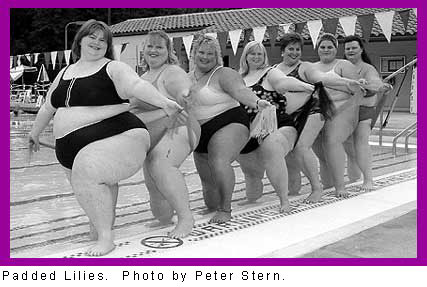 ne of the best bits of
positive publicity about us big folks lately was the Padded Lilies on
Jay Leno’s Tonight Show (NBC-TV) on July 13, 2000; the show
re-aired on September 4. This team of large ladies in bathing suits (see
Radiance,
ne of the best bits of
positive publicity about us big folks lately was the Padded Lilies on
Jay Leno’s Tonight Show (NBC-TV) on July 13, 2000; the show
re-aired on September 4. This team of large ladies in bathing suits (see
Radiance, 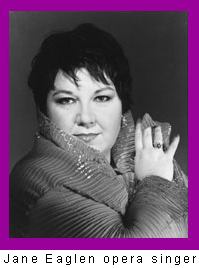 cover story about Jane Eaglen emphasized what a remarkable,
down-to-earth woman she is. Apparently, Ms. Eaglen, a supersize woman,
is engaged to be married shortly, loves to chat on her AOL account, and
enjoys hard rock as much as opera, viewing her career as her job, not
her entire life. Says author Brooks Peters, “Eaglen doesn’t fit the
stereotype of a reigning superstar. In this age of marketable singing
actresses who pride themselves on being nimble and trim, the
thirty-eight-year-old Eaglen is a throwback to an earlier age of Wagner
sopranos, resplendently zaftig and. . . proud of her appearance. [She
makes] no apologies for her weight, arguing that as long as she’s
healthy, it’s no one else’s concern. If a director won’t work with
her because of her size, she says, that’s his problem, not hers. Such
candor and defiance are refreshing, if controversial.”
cover story about Jane Eaglen emphasized what a remarkable,
down-to-earth woman she is. Apparently, Ms. Eaglen, a supersize woman,
is engaged to be married shortly, loves to chat on her AOL account, and
enjoys hard rock as much as opera, viewing her career as her job, not
her entire life. Says author Brooks Peters, “Eaglen doesn’t fit the
stereotype of a reigning superstar. In this age of marketable singing
actresses who pride themselves on being nimble and trim, the
thirty-eight-year-old Eaglen is a throwback to an earlier age of Wagner
sopranos, resplendently zaftig and. . . proud of her appearance. [She
makes] no apologies for her weight, arguing that as long as she’s
healthy, it’s no one else’s concern. If a director won’t work with
her because of her size, she says, that’s his problem, not hers. Such
candor and defiance are refreshing, if controversial.” olve that problem and a lot of health-related issues will
become less pronounced. With this in mind, I have to take seriously
Frances M. Berg’s new book, Women Afraid to Eat: Breaking Free in
Today’s Weight-Obsessed World (Healthy Weight Network, $17.95, 376
pages). The book is packed with helpful information, not just for women
with eating disorders but for everyone else concerned with weighty
issues. For example, well-known dietitian Dayle Hayes (see Radiance feature, Winter 1995) contributes a
chart entitled “Loving Your Body.” On another page, Hayes
brilliantly summarizes half of the think-positive stuff I’ve been
struggling to include in this column in recent years. Bravo!
olve that problem and a lot of health-related issues will
become less pronounced. With this in mind, I have to take seriously
Frances M. Berg’s new book, Women Afraid to Eat: Breaking Free in
Today’s Weight-Obsessed World (Healthy Weight Network, $17.95, 376
pages). The book is packed with helpful information, not just for women
with eating disorders but for everyone else concerned with weighty
issues. For example, well-known dietitian Dayle Hayes (see Radiance feature, Winter 1995) contributes a
chart entitled “Loving Your Body.” On another page, Hayes
brilliantly summarizes half of the think-positive stuff I’ve been
struggling to include in this column in recent years. Bravo!|
|
||
|
Radiance. |
||
|
This site maintained by Cory Computer Systems. |
||

